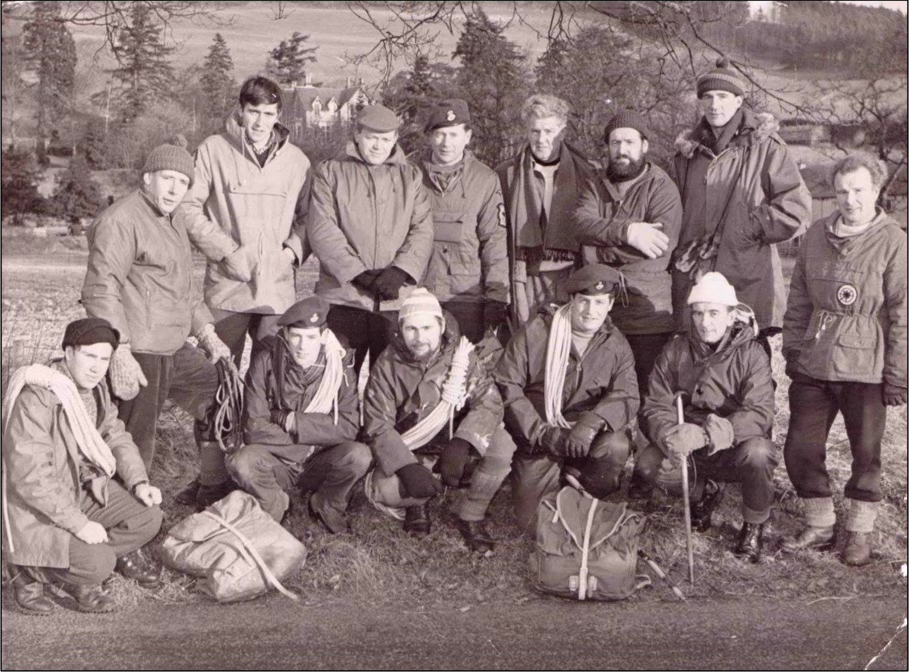
1950s

The Early Days

The team can trace its early beginnings back to the Cheviot Walking Club in the early 1950’s. In September 1963 the first search and rescue team was formally recognised in the Borders. Originally the only one of its kind in the South of Scotland and North-East of England, the group of volunteers was named the Border Search and Rescue Unit (BSARU – see page 70).

The idea behind the formation of the original unit was prompted mainly because of an increase in the number of people, particularly young and inexperienced in hill craft, walking the Cheviot Hills in all seasons, and because of the then recent deaths in a snowstorm of two shepherds on the Northumberland side of the Cheviot. Added to this was an increase in the number of incidents in both the Tweedsmuir and Lammermuir Hills.
By 1969, the unit consisted of three sections – the Roxburghshire Section based at Yetholm; the Berwickshire Section based at Duns and the Selkirkshire Section based at Galashiels.

The section based in Galashiels quickly became established as a team in its own right and at its AGM in November 1973 was re-named the Tweed Valley Mountain Rescue Team (TVMRT). By May 1974 the team had become affiliated to the MRCofS.

Local police officer Tony Robinson headed up the Selkirkshire Section until 1971.

Tony had been a member of the BSARU in Yetholm and was behind the formation of the original Selkirkshire section when posted to Galashiels.

Other members consisted of two ATC Officers Jim Cramb and George Oliver, two young ATC cadets Kenny Morison and Jim Cochrane, and a few local hill walkers including Bobby Jamieson, Douge Bonner, Jimmy Rae, Jim Millar, Jim Crosbie, Bill Kennedy and David Douglas. Jack Sugden took over the unit in 1971 and was followed by Jim Cochrane in 1974.

Jim held the post of Team Leader for over 20 years until 1996 and was a driving force behind TVMRT as it grew from these very early beginnings.

For the past 20 years the team has operated a system of changing team leader every 3-4 years to ensure a healthy turnover and opportunity for those interested to experience the role.

In the early days the team met every Wednesday evening in a local Galashiel’s pub for training.

As no equipment was available, an obvious priority was to raise funds and to improvise equipment from anything the newly formed team could utilise. Jim Cramb, the team’s secretary started to write to both local and multi-national companies to ask for sponsorship. Soon afterwards the first items of kit were acquired. A homemade wooden stretcher was built by members.

It was so heavy it needed four members to lift it even without the added weight of a casualty! First aid kits consisted of Second World War wound dressings and issue bandages donated from the pharmacy department of Peel Hospital and an ex-army sleeping bag that was used as a casualty bag. Things began to look up when the Wills Tobacco Company sponsored the purchase of a MacInnes stretcher. The Belfast Rope Company donated a couple of nylon ropes and Sir James Martin who was Chairman of the Martin Baker Ejector Seats Company donated £25. Lyle and Scott, the famous Hawick Knitwear Company made an unusual donation of several pairs of Y-front underwear to be raffled!

The first store room was a small wooden hut at the back of a greengrocers shop in Bank Street, Galashiels. Throughout the years the team’s HQs progressed from a small wooden hut to a purpose built building consisting of a double garage, storeroom, lecture room, kitchen, toilet facilities and a small indoor climbing wall. It opened in 1990 and was built largely by team members with the support of local businesses. The base was located in Selkirk (MR Post No 88).

Team equipment…

Team equipment in the early days was very crude by modern standards. Back then, two CB radios confiscated by the police managed to find their way into the team’s store cupboard and became the team’s first means of communication. The team’s first vehicle was a Land Rover donated by a local Estate. It had lain for some years unused in a barn but following a quick coat of paint and a service was as good as new. At one stage the team purchased for £156 a nearly-new Austin Gypsy 4×4 with only 90 miles on the clock. When the vehicle arrived it had five brand new tyres, a new fire extinguisher, seat belts, window washers and wipers – a real bargain. Personal equipment consisted of traditional ‘tackity’ boots comprising leather with metal tacks for grips.


Members’ waterproofs were made of cotton ventile or nylon. Some members even wore tweed jackets. Not all proposals on early equipment for members proved successful. One enterprising individual suggested that he could obtain ex-naval, blue nylon cagoules.

Every team member was asked to contribute to the cost. Everyone looked forward to their arrival but when they did, it was discovered that they were covered in battle-ship grey paint and leaked like a sieve.

First official call-outs…

One of the first official call-outs was for four young scouts missing overnight on a Duke of Edinburgh walk in the Meggat hills. Very few members possessed telephones which made calling out members a lengthy process. Call organisers had to drive around knocking on doors to waken team members. Following an hour’s drive to the location the team discovered the lads had walked off in daylight none the worse.

During the team’s first structured search, a line search was established involving over 200 people, including team members, neighbouring teams, police officers, forestry workers and members of the public. The theory was that the line would stretch a distance of three miles between two main parallel roads. It took almost two hours to get everyone into position and about two minutes for it to deteriorate into a shambles. During the search the police commandeered an open-backed potato lorry to transport searchers into position.

In 1972 the team attended a rescue at a local beauty spot where two French tourists had fallen a couple of hundred feet. One had spinal injuries and the other was crag fast. Approximately 12 team members, ambulance crew, local gillies with their rowing boat and a couple of local police officers successfully rescued the casualties in an operation which lasted around two hours. This incident early in the history of the team demonstrated the level of working partnerships which have become strengthened over the years.

In 1986, the team was requested to assist with a search for a missing RAF aircraft which had disappeared during a low level flight over the area. The exact crash site location was pinpointed using information provided by the Seismic Station at Eskdalemuir. The impact had caused enough of a ground tremor to be picked up. This was a good example of using lateral thinking to solve search problems, something that is essential today in most cases.

In 1988, 24 members of the team spent three days at the Lockerbie air disaster.

The original task was to search for survivors during the night of the 21st December. By morning team members began to locate the first of many fatalities. This was a difficult and traumatic time for everyone.

Present

The Team Today

Over the years the team has continued to assist the Police and other emergency services, often working alongside members of other rescue teams in the Borders.

The tasks have ranged from the horrors of Lockerbie to rescuing sheep fast on ledges; from searching for missing children to searching for despondent adults; from evacuating injured hill walkers to recovering the bodies of suicide victims; from assisting at times of flood to assisting during periods of heavy snows; and in more recent years, dealing with an increasing number of mountain bike related injuries. Indeed, providing assistance over a much wider remit than the name Mountain Rescue Team might suggest.


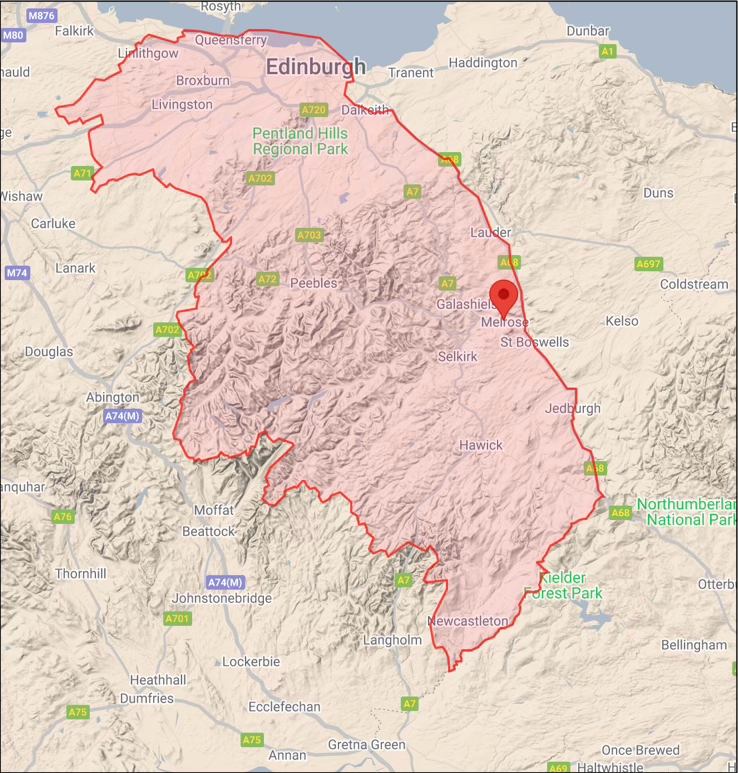
The area covered by the team includes significant expanses of open hill ground, forests, rivers, lochs, as well as villages, towns and the City of Edinburgh – see map previous page. Over recent years (to the end of 2022) around three quarters of call-outs are within the team’s core Scottish Borders area whilst the others are in Edinburgh and the Lothians.

The team is involved in a wide range of tasks with, on average, around 30%  to search for missing persons, 27% for injured mountain bikers, 26% for hillwalkers, and the balance made up of equestrian, civil resilience (weather) and others various jobs. 

In 2021 the team experienced its busiest ever year being called-out on 84 occasions. This amounted to almost 2,400 person hours. Over recent years, analysis of the team’s call-outs shows the trend towards rapid deployments in response to trauma and medical incidents, particularly relating to mountain bikers, and a reduction of lengthy missing person searches from the early years. Overall, demand for the team’s services is following an upward trend.

The team’s annual operating expenses are significant.

Whilst Government funding helps, the team relies on donations and various fundraising efforts by team members and others in order to operate successfully. For example, all team members are currently equipped with purpose-made outdoor clothing thanks to a successful lottery award. The team also owns two Land Rover Defenders and a Mercedes Sprinter Incident Control vehicle. The vehicles are fully equipped with the latest first aid, medical, rescue, and communication equipment.

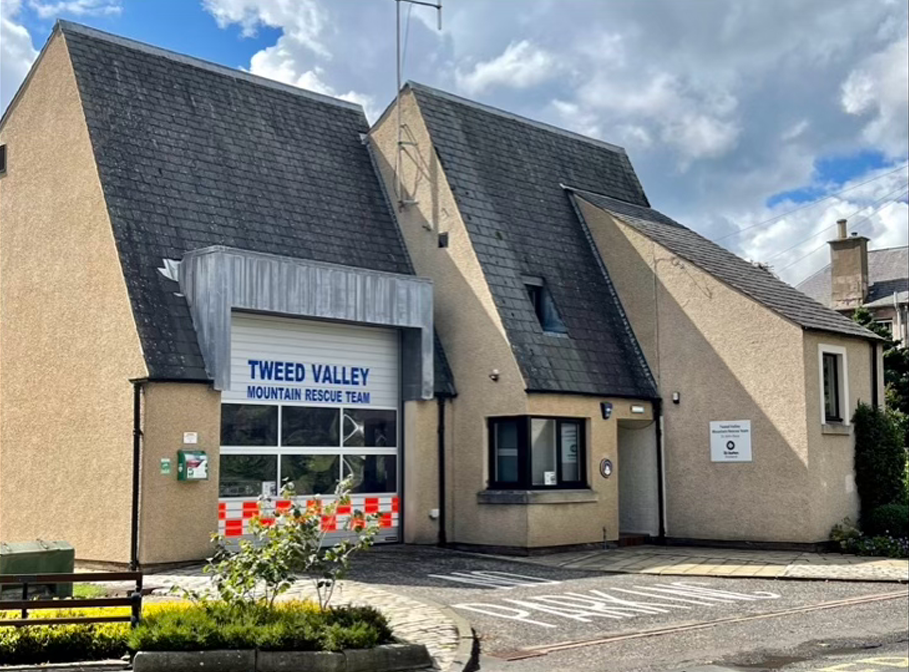
The team purchased and moved into its new base in Melrose (The St John Base) in 2018, with assistance of some generous part-funding from St John Scotland (see below). The team currently has 46 active, full team members. A number of members also have additional roles as search dog handlers and “drone” pilots with SARDA and SARAA respectively. Members support the community with visits to schools, youth and other community groups. Much of this is carried out quietly in the background but is critical in helping to maintain the high profile of the team and its high standing within the communities it serves.

Training is key…

A high priority for the team is to ensure the safety of its own members and those affected by its operations. Training is the key and the team trains members in all the skills required to carry out its main tasks. This includes the softer skills to help look after each other as well as the technical skills more directed at helping others.

In February 2015 the team changed its constitutional status and became a Scottish Charitable Incorporated Organisation. Today, the team is quite different to that which started in the 1960’s. However, it has not changed in one very important way – it is still comprised of committed volunteers from all walks of life who share the desire to help another fellow human who may be suffering and need help. The team will continue to evolve to meet the challenges which lie ahead to assist Police Scotland and the communities of the Borders.